
A bit about me and my background

I am an economist that has practiced in mainstream and alternative traditions for over 40 years. This has taken me to extraordinary places around the world, across four continents, where I have worked for the UN, national governments, NGO’s and academia. Recently, I completed my PhD with the University of Plymouth and was awarded the Schumacher Society Fellowship. This work was supported by peers and supervisors within the Research in Action community. My research tracks my work and life as a practicing economist, to inquire into why the practice of mainstream and many alternative branches of economics leads to experiences of detachment from the everyday world in which ordinary people experience and live their economic lives. I go on to develop a new ‘entangled’ approach to economic thinking and practice that is more responsive to what is happening in everyday economic life and that opens up new pathways to ‘perform’ or bring in to being different types of wellbeing economies.
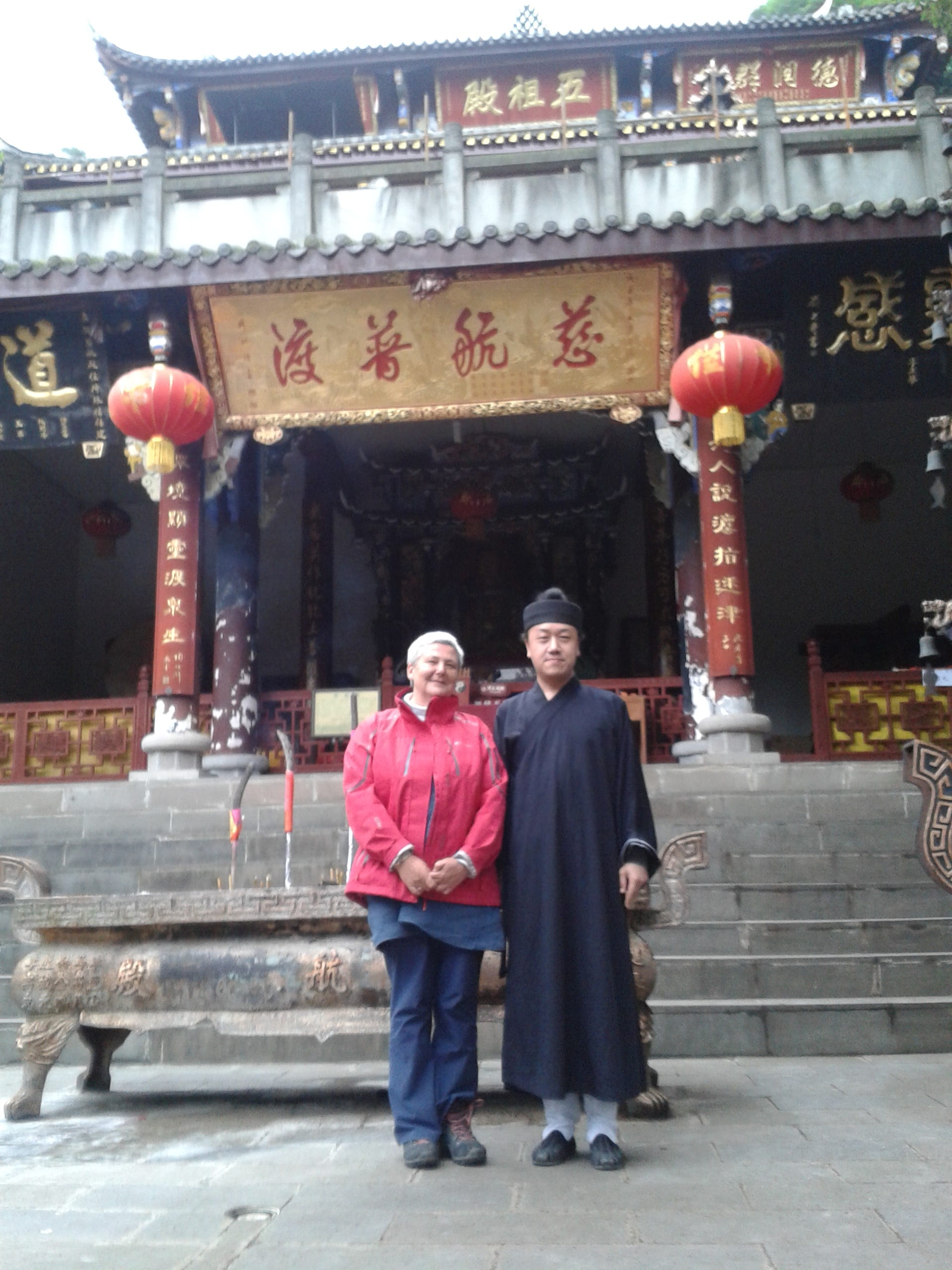
Currently I am Vice Chair of the Sharpham Trust, a registered charity whose purpose is to create a more mindful, compassionate and environmentally sustainable world. Previously I was Head and then Co-Head of Economics [with Jonathan Dawson] in Holistic Economics at Schumacher College in the UK and Director of the Schumacher Worldwide Network. This involved co-creating a new postgraduate programme in Economics for Transition, and various international programmes including The Right Livelihood Programme; the Gross National Happiness Master Class in collaboration with the Gross National Happiness Centre in Bhutan; and Transitioning to an Ecological Civilisation: Dialogues East and West programme in collaboration with South West University and Eco-Daoist Monastries in China. Here’s a picture of me in China posing with a Daoist Master!
I have taught ecological economics and international development at the Universities of London and Sussex and have had the opportunity to work across four different continents: Africa, Asia, Latin America and Europe. This experience has changed my view of ‘development’ – I believe there is much we can learn from the wisdom of other cultures about right livelihood and restoring healthy relationship between human society and nature. But we need to find and develop it in our own culture too!
I have a long standing interest in holistic approaches to science, health and economics. Much of this is informed and inspired by my study and practice of Eastern philsophy, meditation, qi gong, Chinese Medicine and Shiatsu. More recently I have been engaging in inquiry practices, informed by phenomenological, narrative and reflexive methods to cultivate a more responsive approach to economics in the midst of live and fast moving situations. I have also been influenced by current scholars in post humanism and entanglement and agential realism - where new thinking in science is challenging and breaking down the false boundaries and hierarchies we have erected between each other and nature.
Below is a list of some of the projects and organisations that I have engaged with - each in their own way has fuelled my search for an approach to economic thinking and practice that is rooted in the lived experience of everyday economic life rather than abstracted versions of it.
Projects and Organisations
Vice Chair and Trustee of the Sharpham Trust, 2021-present
Senior Lecturer in Holistic Economics and Director of Schumacher Worldwide, Schumacher College, Devon, UK. April 2010 - 2019
Trustee of the Transition Network, Totnes. UK. 2008-10
Founder and Director of the Landscope Project (incubator for social and environmental enterprises), Dartington Hall Trust, UK 2006 – 2010
Principal Sustainability Advisor, working with a range of business clients on corporate responsibility and sustainability accounting and reporting, Forum for the Future, 2001 – 2003
Strategic Environmental Policy Advisor, Strategy Unit in the UK Cabinet Office and the Prime Minister’s Policy Unit, UK Government 1999-2000
Lecturer in Environmental Economics, African & Asian School, Sussex University 1992-1998
Lecturer in Economics, Economics Department, University College London, 1989-1992
Planning Officer, Ministry of Finance & Development Planning, Government of Botswana, 1986-1988
International development and environmental consultant working across different sectors and countries (Africa, Latin America, Asia, Europe) for a range of public sector and NGO clients (including UN, EU, national governments, Save The Children, WWF and The Design Council)
Moves in Economic Thinking and Practice:
Selected Writings and Publications
My moves in thinking and practice from mainstream to alternative economic approaches, and my current focus on entangled economies is also reflected in some of my past writings and publications.
Richardson, J. [forthcoming] Weaving Together Practice and Theory’ . In: H. Wainwright and M. Kaldor, eds., The politics of Production: Tools for solving climate breakdown and filling the democracy void: Essays inspired by the theory and practice of Robin Murray. The Production of Transformative Social Thought. Merlin Press.
Richardson,J. (2025). Forming Economies of Wellbeing through Responsive Practice in Everyday Life. PhD, School of Art, Media and Architecture, University of Plymouth.
Richardson, J.A. [2023]. How does Gross National Happiness offer an integrated perspective linked with health, economics, and nature? Journal of Ayurveda and Integrative Medicine, [online] 14[1].
Kim, J.C., Richardson, J.A., and Tenzin, T. [2023] Weaving Wellbeing into the Fabric of the Economy: Lessons from Bhutan’s Journey Toward Gross National Happiness. In Rieger, E., Costanza, R., Kubiszewski, I. and Dugdale, P. [eds]. Toward an Integrated Science of Wellbeing. Oxford University Press.
Richardson, J. [2018]. Encountering Theories of Change in Economics for Transition. In: G. Kossoff and R. Potts, eds., Can Design Catalyse the Great Transition. Papers from the Transition Design Symposium 2016. School of Design at Carnegie Mellon University, Schumacher College and the New Weather Institute. In association with the Dartington Hall Trust.
Richardson J. et al (2017) Nature’s Blue Value. Chapter 3 in The UNEP Handbook on the Economics and Management of Sustainable Oceans. United Nations Environmental Programme.
Richardson et al, (2011) Resilient Economics in Harding S. (ed) Grow Small, Think Beautiful: Ideas for a Sustainable World from Schumacher College. Floris Books, Edinburgh
Richardson J. and Fleming R. (2007) Using Science to Create a Better Place, Environment Agency.
Richardson, J., Irwin, T. and Sherwin, C., [2005]. RED: Design and Sustainability A scoping report. London: Design Council.
Richardson J. and Cameron C. (2005) Beyond the Rhetoric: Measuring Revenue Transparency in the Oil and Gas Industries. Save the Children UK, London.
Richardson J. (2005), ‘Ancient Insights into the Modern Organisation’ in Richardson K (ed) Managing Organisational Complexity: Philosophy, Theory and Application.. ISCE Managing the Complex, Book Series. IAP Press, Connecticut.
Henriques A.H. & Richardson J. (eds) (2004), ‘The Triple Bottom Line: Does It All Add Up? Earthscan,
Richardson, J. [2004a]. Accounting for Sustainability: Measuring Quantities or Enhancing Qualities. In: Henriques, A. and Richardson, J. eds., The Triple Bottom Line: Does it All Add Up? London.: Earthscan.
Richardson, J.A. [2004b]. Wholeness and Health In the Living Organisation. Dissertation submitted for MSc in Holistic Science. Schumacher College and the Faculty of Science, University of Plymouth.
Richardson J. ( 2002), ‘Checking the pulse: how healthy is your organization?’ Journal of Organisations and People, Vol 9(4). The Quarterly Journal of AMED.
PIU (2000), Rights of Exchange: Social, Health, Environmental and Trade Objectives on the Global Stage. Performance and Innovation Unit, Cabinet Office, UK Government.